SRD Grant FAQs: The Answers SASSA Does Not Explain Properly
I have spoken to dozens of people who got a “Declined” message on the SASSA Status Check and had no idea what to do next. Some gave up. Some paid strangers to “fix” it and lost money to scams. The truth is, the SRD grant system is confusing. The reasons are short. The instructions are unclear. And most websites either copy paste official statements or explain things in language that takes a law degree to understand.
That is why I put together this page. After spending years helping community members navigate SASSA processes, I know exactly what questions people ask most and where the real confusion comes from. This guide answers every common SRD grant question in plain language. No jargon. No guesswork. Just clear, honest answers that actually help you.
R370
Monthly grant amount (2026)
7M+
South Africans receiving SRD
R624
Maximum income to qualify
Mar 2027
Confirmed extension date
What is the SRD Grant?
Quick Answer
The SRD grant (Social Relief of Distress) is a R370 monthly payment from SASSA for unemployed South Africans aged 18 to 60 who have no other income. It is confirmed to continue until March 2027.
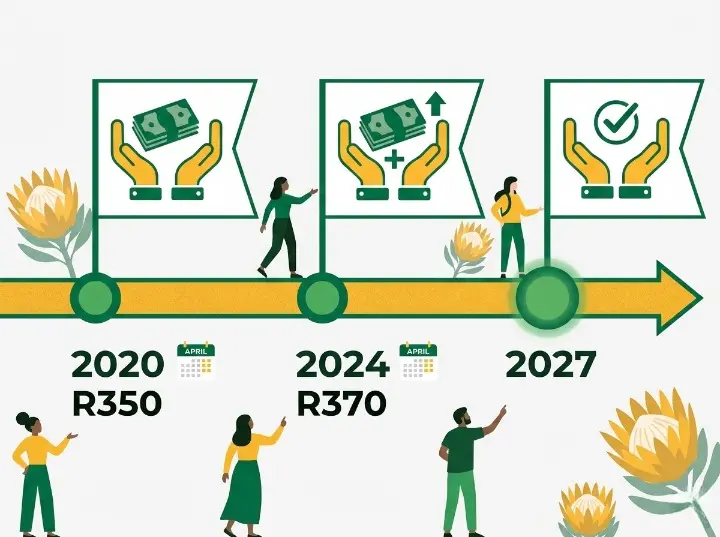
SASSA launched the SRD grant in May 2020 during the COVID 19 pandemic. At the time it was R350 per month. It was meant to be temporary. But because unemployment stayed high, the government kept extending it. In April 2024, the amount went up to R370. As of the 2026 budget, it has been extended to March 2027 with R36.4 billion set aside to keep paying it.
Unlike the Older Person’s Grant or Disability Grant which are paid every month once approved the SRD grant is checked every single month. SASSA scans your bank accounts, UIF records, NSFAS status, and Home Affairs database before each payment. You can be approved in January and declined in February if your financial situation changes.
Eligibility of SRD Grant FAQs
This is where most confusion starts. People are unsure if their situation qualifies. Here are the rules explained simply.
Who can apply for the SRD grant?
Frequently asked eligibility questions
SRD Grant Application FAQs
How do I apply for the SRD grant?
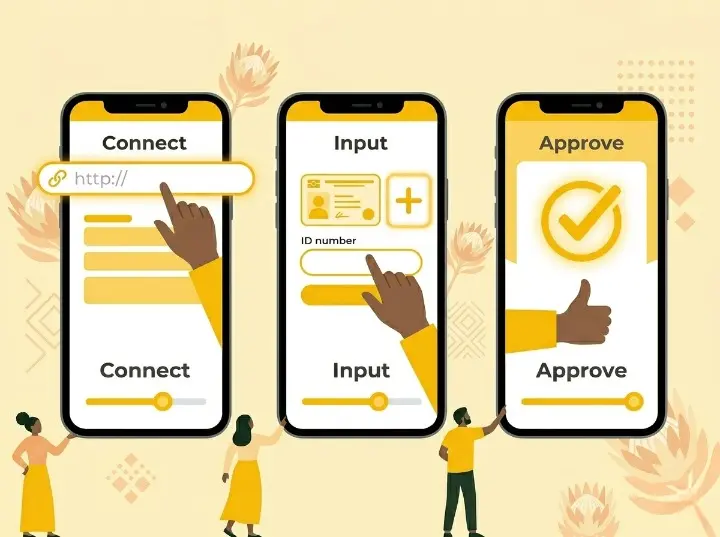
- Online srd.sassa.gov.za Visit the official site on any browser. Click “Apply Online.” Enter your ID number, phone number, and personal details. Make sure your name matches your ID exactly.
- WhatsApp 082 046 8553 Save this number and send “Hi” to start. Follow the chat prompts. This works even on basic smartphones.
- USSD Dial *134*7737# No internet needed. Works on any phone, any network. Data costs do not apply for USSD.
⚠️ New requirement from 2026:
Biometric verification New applicants must complete biometric verification fingerprint and facial recognition matched against the Department of Home Affairs database. You do not go to an office for this. It is done digitally through the portal or a SASSA-approved channel. If the biometric check fails, you will receive a notification and need to contact the SASSA helpline (0800 60 10 11) to resolve it before your application can proceed.
Application FAQs
SRD Status Check FAQs
|
How to check |
Method |
Data needed? |
|
Online portal |
srd.sassa.gov.za → Application Status |
Yes (internet) |
|
USSD |
Dial 1347737# on any phone |
No (free USSD) |
|
|
Send “Hi” to 082 046 8553 |
Yes (WhatsApp data) |
|
Moya App |
Download Moya App, open SASSA section |
No (data-free app) |
What does each status message mean?
Why Was My SRD Grant Declined? (All Reasons Explained)
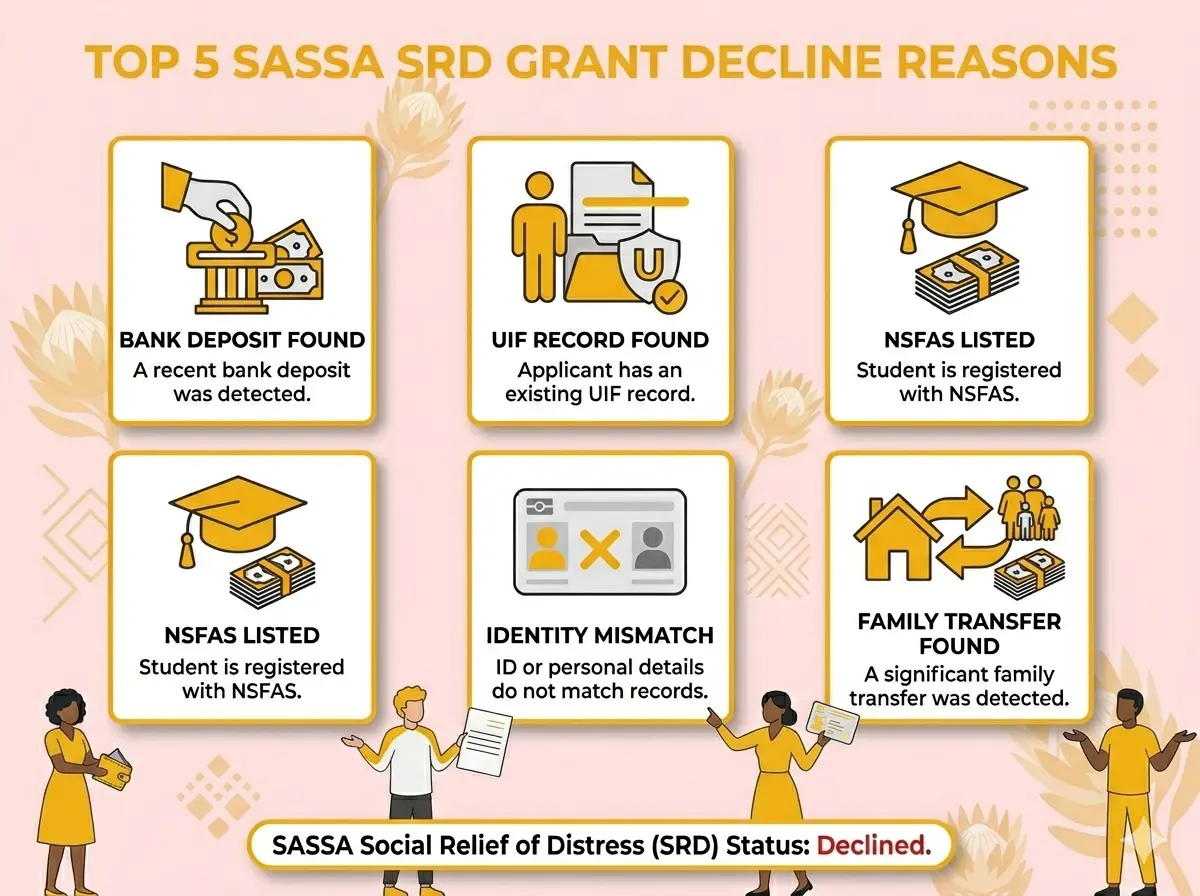
A declined status does not always mean you did something wrong. The system is automated and it makes mistakes. Here are every common decline reason and exactly what to do about each one.
Reason 1: Bank deposits over R624
SASSA checks your bank account every month. If any deposits push your total over R624, you get declined even if it was a gift, a family transfer, a refund, or a stokvel payout. The system does not know the type of deposit, only the amount.
Fix:
Appeal and explain the deposit. Be specific: say it was a once off family transfer, not a salary. Ask the person who sent the money to write a short explanation. If possible, use a bank account that only receives your SRD payment to avoid false triggers in future months.
Reason 2: UIF record still active
Your previous employer may never have deregistered you from UIF when you left. SASSA sees you as “actively receiving UIF” even though you have not touched it in months.
Fix:
Contact the Department of Employment and Labour and ask them to remove you from the active UIF database. Once they update their records, your next monthly check should clear. You can also appeal with a letter confirming you are not receiving UIF.
Reason 3: NSFAS still showing as active
If you dropped out of university or graduated, NSFAS may still list you as an active student receiving funding.
Fix:
Go to your campus financial aid office and get a formal clearance letter confirming you are no longer funded. Submit this letter as part of your appeal. Without this letter, the NSFAS record will keep blocking your approval.
Reason 4: Name or ID mismatch with Home Affairs
If you entered a nickname, made a typo, or your surname changed (marriage, divorce) and Home Affairs records are not updated, the identity check fails.
Fix:
Double check your name exactly as it appears on your ID book or smart card. If Home Affairs records are incorrect (for example, listing you as deceased), you must visit a Home Affairs branch in person to correct this before SASSA can approve you.
Reason 5: Stokvel or e-wallet deposit
This is a gap that almost no website talks about. Stokvel payouts and e-wallet transfers (from FNB, Capitec, or other banks) are counted as income by SASSA’s system. Even though these are community savings or informal loans not a salary the system flags them.
Fix:
Appeal and explain the nature of the payment. If it was a stokvel payout, a simple written statement from your stokvel group explaining the structure helps. Ask the sender to avoid using e-wallet transfers to your account in months when you need SASSA to approve your grant.
Reason 6: Receiving another SASSA grant
You cannot receive the SRD grant at the same time as any other SASSA grant. This is a hard rule with no exceptions except the caregiver scenario explained in the Eligibility section above.
Fix:
If you believe this is wrong, check if a grant is being paid to your ID number without your knowledge. Contact SASSA directly on 0800 60 10 11 to investigate.
How to Appeal a Declined SRD Grant
First: Reconsideration vs Formal Appeal know the difference
Most websites mix these up. A reconsideration is asking SASSA to re check your application with more information you do this through the SRD portal. A formal appeal goes to the Independent Tribunal for Social Assistance Appeals (ITSAA) a completely separate body from SASSA. Always try reconsideration first.
Step by step appeal process
- Go to srd.sassa.gov.za Click “Appeal” on the homepage. This takes you to the official appeals portal.
- Enter your ID and phone number Use the same phone number you used when you applied. Click “Send PIN” and enter the OTP you receive.
- Select the declined month Each month is treated separately. If you were declined for March and April, you need to submit two separate appeals.
- Choose your reason and explain Pick the reason that matches your decline. Then write a clear explanation. Be specific: “The deposit on date was a once off gift from my sister, not employment income.”
- Upload supporting documents if asked Bank statements, a letter from whoever sent money a UIF deregistration letter or NSFAS clearance letter depending on your decline reason.
- Submit and save your reference number You will receive an SMS confirming your appeal. Keep this number. The appeal can take 60 to 90 days. You will not receive payment during this time.
SRD Grant Payment FAQs
Payment methods available in 2026
|
Payment method |
How it works |
What you need |
|
Bank account deposit |
Paid directly into your personal bank account |
Account must be in your own name |
|
Retail collection |
Collect cash at Pick n Pay, Shoprite, Boxer, Checkers, USave |
Your South African ID |
|
Postbank Black Card |
New card replacing the old SASSA Gold Card |
Visit Shoprite, Checkers, Pick n Pay, or Boxer Postbank point to swap |
Postbank Black Card what you need to know
The old SASSA Gold Card is being replaced by the Postbank Black Card. If you still have a Gold Card, visit your nearest Postbank point at Shoprite, Checkers, Pick n Pay, USave, or Boxer to get your new card. The Black Card works wherever Mastercard or Visa is accepted. There is no cost to swap.
SRD Grant Scam and Fraud FAQs
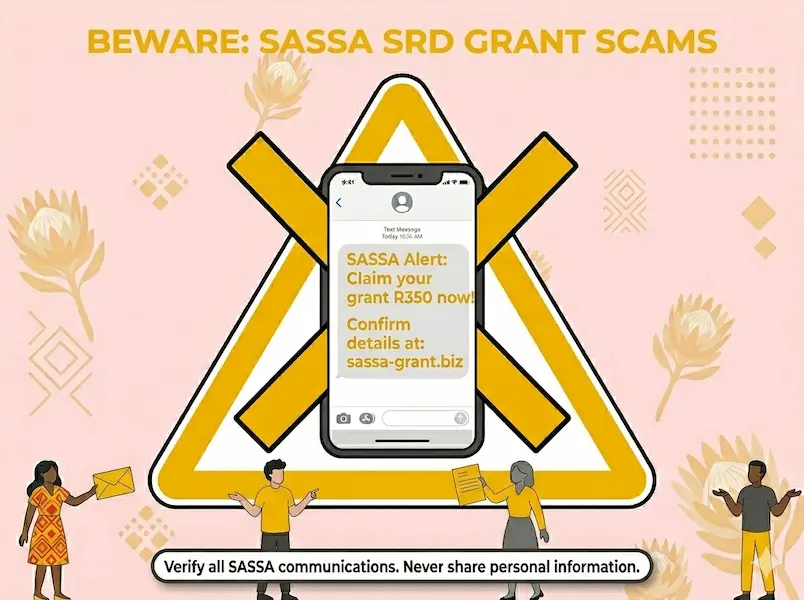
SASSA will NEVER ask you for money
All SRD applications, appeals, and status checks are 100% free. Anyone asking for a fee to “unblock” your grant, “speed up” your application, or “fix” your status is a scammer. Report them to SASSA on 0800 60 10 11.
Red flags to watch for
Future of the SRD Grant What is Coming?
Many people are asking whether the SRD grant will be cancelled or changed. Here is what we know as of May 2026.
|
Update |
Status |
What it means for you |
|
SRD grant extended to March 2027 |
✅ Confirmed |
Your R370 payments continue unchanged until at least March 2027 |
|
Biometric verification for new applicants |
✅ In effect now |
New applicants need fingerprint and facial verification |
|
Removal of some income questions from application form |
⏳ Proposed |
Court rulings have pushed DSD to simplify the form not yet official |
|
Livelihoods Support Grant pilot |
⏳ Planned (late 2026) |
Pilot in Gauteng, Eastern Cape and Limpopo watch for official announcement |
|
Basic Income Support Grant |
⏳ Under discussion |
Government is debating a permanent grant to replace SRD no confirmed date yet |
What this means for current beneficiaries
If you are currently receiving the SRD grant, nothing changes for now. Keep checking your status monthly. The R370 amount stays the same. The only change that may affect you is the Postbank Black Card swap if you are still on the old Gold Card.
SRD Grant vs UIF Key Differences
People often ask whether they should be on SRD or UIF. You cannot receive both at the same time. Here is how they compare.
SRD Grant (R370/month)
1: For people who have never worked or have no UIF contributions
2: No contributions required you just need to be unemployed
3: Checked monthly can be declined any month
4: R370 flat amount no sliding scale
5: Apply at srd.sassa.gov.za
UIF (Amount varies)
1: For people who previously worked and had UIF deducted
2: Requires employment history and UIF contributions
3: Paid for a set period based on your work history
4: Typically higher than R370 per month
5: Apply at ufiling.labour.gov.za
If you previously worked and have UIF contributions, apply for UIF first the amount is higher. Once your UIF period ends and you are still unemployed you can apply for the SRD grant. You cannot receive both at the same time.
Key takeaways from this guide
1: The SRD grant is R370/month and confirmed until March 2027
2: Your eligibility is checked every month you do not reapply
3: A “Declined” status can often be fixed always appeal within 90 days
4: The most common decline cause is bank deposits over R624 even gifts count
5: Stokvel payouts and e-wallet transfers can trigger false declines
6: The Postbank Black Card has replaced the old SASSA Gold Card
7: All SASSA services are 100% free anyone charging you is a scammer
8: Two people in the same house can both receive the SRD grant
Final Thoughts
The SRD grant system is not perfect. Over 1.2 million applications were declined in early 2026 alone and the Institute for Economic Justice found that around 68% of those declines were triggered by once off deposits, not actual income. If you have been declined, the most important thing I can tell you is this: do not give up. Appeal. The process exists for a reason, and it works when you give it the right information.
In my experience, the people who get stuck are the ones who do not know why they were declined. Once you understand the reason whether it is a family transfer that triggered the income flag, an old UIF record you never knew was active, or an NSFAS file that was not cleared after you left university the fix is usually straightforward. Keep your bank statements. Keep records of who sends you money. And check your status every single month, because the system changes your result month by month. This guide will be here when you need it, and I update it every time SASSA makes a change.